

Artificial Intelligence continues to transform industries around the world, but one critical challenge remains unsolved: how AI systems decide which information should influence learning the most.
A new conceptual framework called the Epistemic Weight Engine (EWE) aims to address this challenge by introducing reliability-aware learning in machine intelligence.
The idea has been proposed by Maheep Purohit, Project Head at JJP TECH and the inventor of the Adaptive Intelligent Pipeline Integrity System (AIPIS).
A New Idea in Machine Learning
Traditional machine learning systems update their internal parameters using every training example. While this approach works in controlled datasets, real-world data is often imperfect.
Many datasets contain:
- noisy labels
- unreliable signals
- human annotation errors
- inconsistent information sources
Despite these issues, most models treat each data point with roughly equal influence during training.
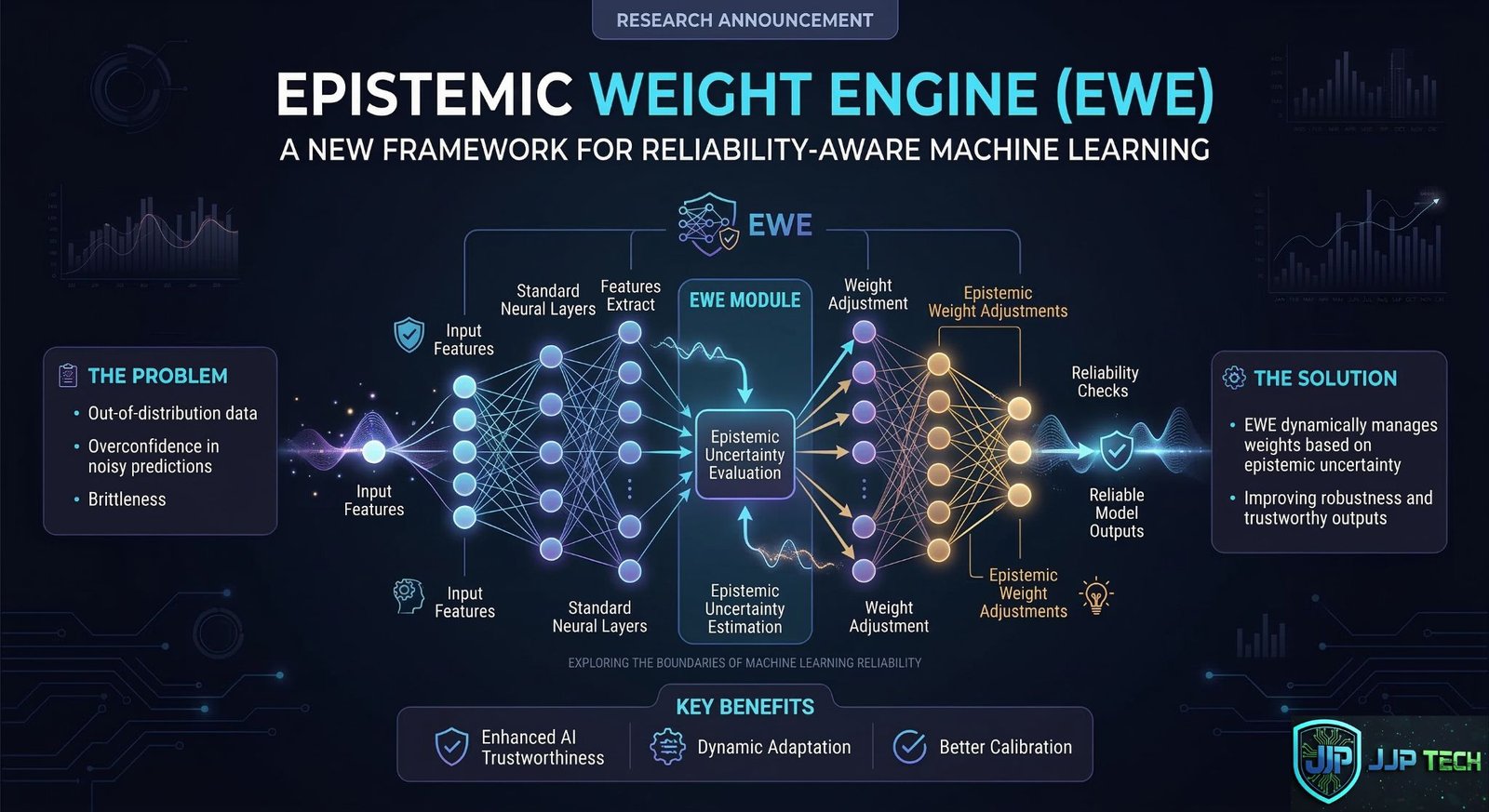
The Epistemic Weight Engine (EWE) introduces a conceptual architecture designed to address this limitation.
Instead of allowing every data sample to equally influence model updates, EWE introduces a gating layer that evaluates the epistemic reliability of incoming information before the learning update occurs.
The learning pipeline can be summarized as:
Data → Epistemic Evaluation → Weighted Learning Update
This mechanism allows machine learning models to prioritize reliable information while reducing the impact of misleading data.
From Industrial Innovation to AI Research
Maheep Purohit currently serves as Project Head at JJP TECH, where he leads technological innovation projects.
He is also the inventor of AIPIS (Adaptive Intelligent Pipeline Integrity System), a predictive infrastructure technology designed to identify potential pipeline failures before they occur.
The exploration of intelligent monitoring systems and predictive architectures eventually led to broader questions about how machines interpret and evaluate information during learning.
This curiosity became the foundation for the Epistemic Weight Engine research concept.
First Research Preprint Published
The first research preprint describing the Epistemic Weight Engine has now been published on the open research repository Zenodo, making the concept publicly available for the research community.
📄 Read the research paper:
https://zenodo.org/records/18940012
The paper presents the theoretical framework, architectural design, and an experimental roadmap for evaluating the EWE approach.
Future Research and Experiments
The next phase of development will focus on validating the Epistemic Weight Engine through practical experiments.
Planned research includes:
- implementing EWE within neural network training pipelines
- evaluating performance on noisy-label datasets such as CIFAR-10N
- comparing results with existing robust learning methods
These experiments aim to determine whether reliability-aware weighting can improve machine learning performance under imperfect data conditions.
Emerging Independent Research from India
The publication of this work highlights the growing role of independent research initiatives in emerging technology ecosystems.
Working from Rajasthan, India, Maheep Purohit represents a new generation of young innovators exploring ideas at the intersection of artificial intelligence, engineering systems, and predictive technologies.
Through initiatives at JJP TECH and ongoing independent research efforts, the goal is to contribute to the development of more reliable, intelligent, and resilient AI systems.
About JJP TECH
JJP TECH is an innovation-driven technology initiative focused on advanced research, engineering solutions, and emerging technologies. The organization supports projects in artificial intelligence, predictive infrastructure systems, and intelligent industrial monitoring.